




In this episode of the Expand Your Empire Podcast, we explore a powerful truth. Many smart, capable women still feel disconnected from money and delay claiming their financial power. Why? Host Amanda Taylor unpacks what she calls the wealth wound, the deep-rooted conditioning that causes women to defer financial decisions, question their abilities, and feel unqualified to build long-term wealth.
Inside this episode, you’ll learn:
- The real reason why women hesitate to invest or lead with money
- How generational beliefs and cultural narratives keep women playing small
- What research says about women’s investing performance
- Why intuition, patience, and values-aligned decision-making are major financial strengths
Amanda also shares part of her own journey, including the moment she realized she had handed over her financial power and how she began to take it back.
If you have ever felt uncertain, behind, or overwhelmed by money, this episode offers both clarity and encouragement. You already have what it takes. Now it’s time to remember and rise.
—
Watch the episode here
Listen to the podcast here
The Wealth Wound: Why Smart Women Still Hold Back With Money
Understanding The Hidden Beliefs That Keep Women From Claiming Financial Power And How To Start Rewriting Them
Welcome back, empire builders. I’m glad you chose to come back with me. It’s an important episode for me because we’re continuing on the why. Why am I doing this? Why am I talking to you? Why am I building a community? I want to talk about why so many smart and capable women are still hesitating when it comes to money. I want to go deep into the patterns that we’ve inherited and how we can start letting them go. It’s in all of us.
It’s very nuanced and it’s very layered, and it comes with a lot of baggage, history, shame, and strange feelings that come up, and even visceral. I know a lot of people don’t talk about it at all. A lot of people have bad memories of it. It’s so nuanced. I understand bad money stories. I want to set the theme that we want to talk about, which is truth-telling and trust-building. None of what I teach and what I want to build is wrapped around shame. It’s not about pointing fingers.
Alarming Statistics About Women And Money
It’s about naming what has been in the room for generations, and choosing something different. I wanted to start with statistics because I love data. I’m a data nerd. It’s shocking that the more of this stuff that I learn and read, the more passionate I become talking about this stuff with my audience and my people. There’s a lot of baggage that comes along with this.
I’m going to read through some of these statistics that are crazy. Let me see. This is UBS. This is an actual publication. ChatGPT did not make these up. Fifty-six percent of married women leave their investment in financial planning decisions to their husbands. I 100% did this. If there was a meeting with a financial advisor, I was like, “I don’t need to be a part of that. I don’t know anything about that. I’m not going to do it.” I was one of those. Eighty-five percent of married women who stay out of long-term financial decisions believe that their spouses know more about their financial matters. We are assuming that they are better at it than we are.
Eight out of ten women are content with the current distribution of financial responsibilities in their marriages, and 80% of women will end up alone. We are living longer than men. Ninety-eight percent of divorces and widows would advise other women to take an active role in their finances now. This one shocked me the most. Millennial women are more likely to leave investment decisions to their husbands, 61%, than older generations. I was floored by that. I thought for sure it would have been the opposite, that the younger women were taking control where the rest of us had dropped the ball.
If you didn’t know before, I am a proud Gen-Xer. I’m at the tail end of being a Gen-Xer, but I will own it till the day I die. I was shocked that Millennial women are more likely to defer those decisions. Saying, “I’m not good with money,” where does that come from? I said it. What is the deeper truth? I think it was that we were never invited into the conversation and not just in our relationships. I don’t remember having that conversation in my family growing up. Nobody talked about it.
It’s not that we don’t want to engage in these conversations. It’s just that we’ve been conditioned to believe that it’s not our sandbox to play in. It’s been the guys’ club. It’s a masculine area, this finance, the crypto bros, the stock stuff. It’s a masculine energy, and we haven’t felt like we’re a part of it. I don’t have this statistic in front of me, and I will butcher it, so have some grace with me here.
[bctt tweet=”Women are conditioned to believe that financial conversations are not their sandbox to play in because it is a masculine area.” via=”no”]
Women are 25% more likely to say, “I don’t know,” when they’re asked a question about their finances. The majority of women don’t invest because they think they don’t have enough knowledge. They don’t know enough. What I want to call out with that is, do you want to learn? Is it that you don’t know enough and you’re happy with that? Do you really want to learn? Are you willing to engage with money like it matters?
You don’t have to know it all. You just have to be willing to learn. Not knowing is not a flaw. It’s an opportunity. It’s a moment of power because now you get to choose. When I first found that agency in myself, that I could not only learn something, but feel confident in it and make that choice and have that freedom to invest in that thing, that is power. That is a choice. That is freedom. Not knowing that I could do that and then being able to do that is a huge moment, and I want more people to be able to experience that.
Why Women Are Not Risk-Averse
Women’s portfolios outperform men’s by like 0.04% or 0.4%. Again, I’m butchering statistics. It’s a gift. What it means is even though it’s a small amount, over time, compounding that is a huge difference. What I want to reframe is that you hear a lot of people say that women are risk-averse, risk aversion. I don’t think we’re risk-averse. I think we’re risk-aware. What do I mean by that? I mean that we have so many natural strengths that come into these decisions.
We’ve got more long-term thinking. We do more research. We have a more community-centered heart and plan. We have intuition. Believe it or not, I learned this. Our right and left brains speak to each other when men do not. We have different ways of thinking about things and seeing things that provide more insight. We don’t get shiny object syndrome as much. We have more forward-thinking, long-term thinking when it comes to making these decisions of what we’re going to invest in.
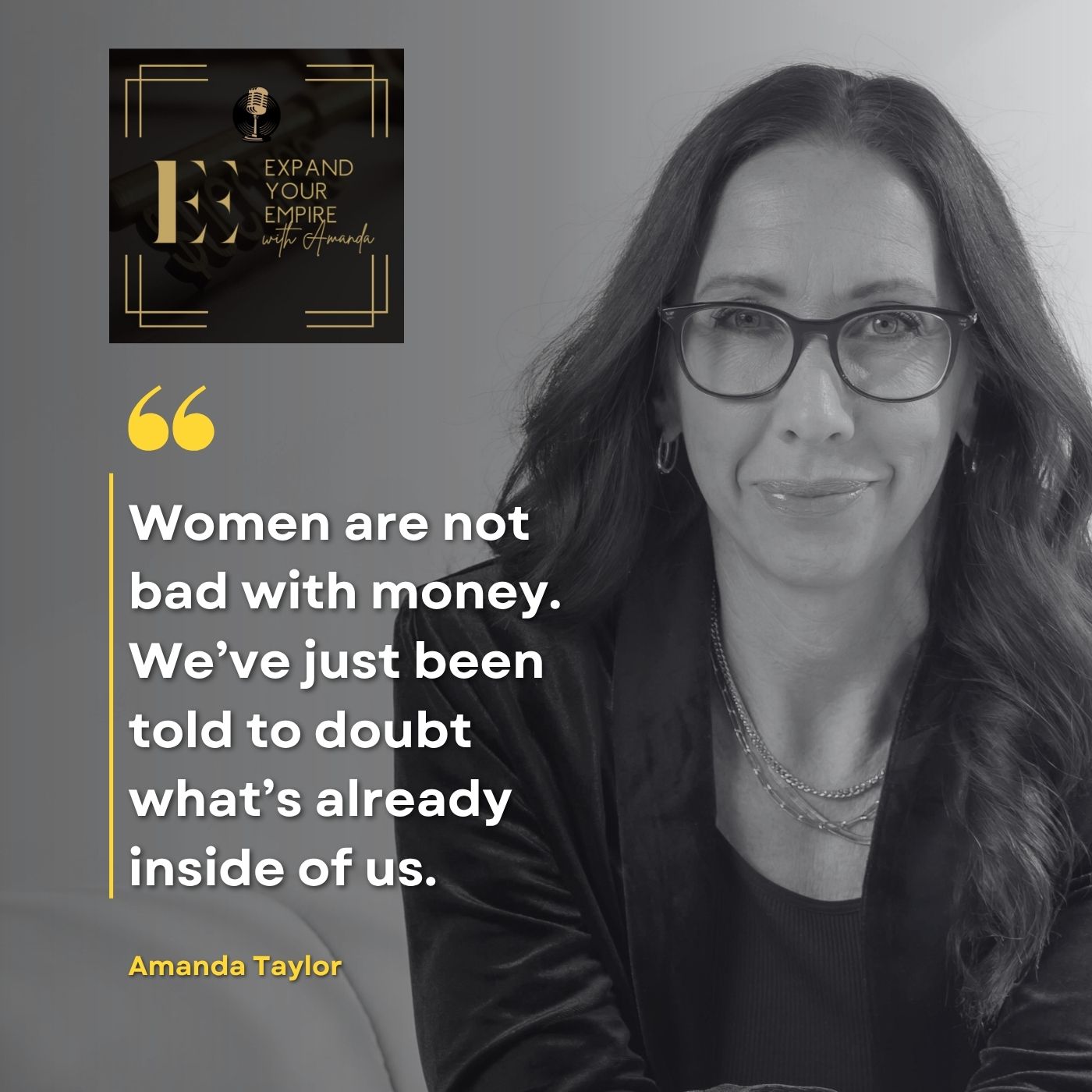
It’s not aversion, it’s awareness. Reframe that in your own mind. “I am not risk-averse, I am risk-aware. I make choices based on my values and my intuition.” That all comes back to you building your confidence, and us building our sovereignty. We are not bad with money. We’ve just been told to doubt what’s already inside of us. Where does that come from?
You hear all the time, “What’s your money story? What are your money beliefs?” I had to go through that too. I’m still going through it, if I’m being honest, but inherited money beliefs. That money is hard and we cannot afford it. What stories did you hear when you were growing up, and what stories did you not hear and you just witnessed? I think I said it in the first episode that until 1974, a woman could not get a loan or a credit card without a male co-signer, a husband, a father, or even a son.
It is ingrained in us to believe that we’re not worthy, smart enough, or capable of handling this power. Someone else should do it. We’re taught to pinch pennies and budget, and clip coupons. We’re taught to be small in so many ways. Money, save it, don’t spend it. Watch what you buy. All of these things. How have we identified our safety and our worth with any financial power?
All of those stories, “What did you see your grandparents do? A lot of people my age had grandparents in the depression. If you’re younger than me, you may not have had that same story.” The generational big T or little T trauma that is running through us that has those stories that have been passed down, money is such a huge part of how we see ourselves and how we operate in the world, and how we get value out of things, even though we need to change that.
We have such an ingrained belief about it. Until we start to investigate how we feel about money, especially if we’re running a business, I believe that my entrepreneurial ladies here running and building a business, there are money beliefs personally, and they’re affecting your business, your bottom line, your revenue, your profit, and your pricing. We have to notice, not judge, but witness what those beliefs are.
How To Change Your Money Beliefs
You don’t even have to identify where they come from. We just need to be aware of them so that we can work with them to get to the next level. I know this is tender work, and it can take a long time, but it’s that tenderness that leads us to our strength. What do we do? It is hard work. I’ve met some women in business owning their own business, running the show. They are strong, capable, confident, and they refuse to look at their bank account because they are afraid, ashamed, or embarrassed.
Have a daily check-in. Look at your account for 30 seconds each day with total neutrality. This just is. It is not good. It is not bad. It just is. Say out loud, “I’m allowed to be here. That’s just it.” Journal or ask yourself, or write yourself a voice note. “What do I believe about money that may not be mine?” Evaluate that. What do I believe about money that may not be mine? Learning how to identify with those beliefs. “Is it true? Is it mine?” Make one small financial move this week, anything.
From transferring $20 to a savings account to pricing one of your offers with clarity. Confidence doesn’t come first. It comes from showing up over and over again. I just want to remind you that we’re not broken. We’re powerful. That’s why we’re here. Knowledge is available, but the wisdom is already within. I say it all the time.
[bctt tweet=”Confidence does not come first. It comes from showing up over and over again.” via=”no”]
Education and intimidation have an inverse relationship. If this is something you want, if this is a power that you want, if this is a dream that you have to live this life where wealth and money and abundance are part of your everyday life with no shame and no fear, let’s stop being intimidated by it and let’s get educated. Come and be part of our community.
Expand Your Empire is all about laying that foundation of learning, of building confidence, and using our wisdom to do what we already know how to do, but put it into practice. You have a voice. You have a choice. Your power with money has been there all along. It’s just waiting for you to claim it. I want to thank you for hanging out with me for a few minutes of your day.
I want to keep this conversation going. Let me know if this resonated with you. I would love to see you in our community, where we can learn together, we can share together, and grow together. I hope to see you in there, and I cannot wait to see you in our next episode. Thanks for stopping by, and we’ll see you next time.
Important Links
- Amanda Taylor on LinkedIn
- Amanda Taylor on Instagram
- Expand Your Empire
- Expand Your Empire on Facebook