





Feeling overwhelmed by daily decisions and disconnected from your finances? You are not alone. Amanda Taylor explores the powerful connection between decision fatigue, women and money, and the hidden costs of outsourcing financial power.
Through a personal story of transformation, you’ll learn:
- How mental load and financial overwhelm go hand in hand
- Why women are 33% more likely to defer financial decisions
- The surprising truth about the gender gap in financial literacy
- Why financial confidence for women matters more than perfection
- 3 simple ways to take back your money mindset and decision-making power
Whether you are a high-achieving woman, a new investor, or someone ready to build wealth with clarity, this episode is your invitation to stop playing small.
🔗 Join the Expand Your Empire community — where ambitious women take ownership of their time, energy, and financial future. https://community.expandyourempire.org/invitation?code=C69C6J
—
Watch the episode here
Listen to the podcast here
Stop Outsourcing Your Power: Women, Money, And Decision Fatigue
How Everyday Exhaustion Silently Drains Women’s Financial Power And What You Can Do To Reclaim It
How many decisions have you made today? For me, it’s not even 9:00 AM. What’s for breakfast? Who is picking up the kids? Did I pay that bill? Did I send the email? Our brains are burnt out before we even have coffee. Empire builders, welcome back to Expand Your Empire. Today, we are talking about power, your power, specifically, the kind we give away in the name of love, convenience, or what we think is maybe not our job.
How Real Estate Transformed My Financial Power
This one is for my ladies especially, because we need to talk about money, decision fatigue, and why it’s time to stop outsourcing that power. Early on in my marriage, I was totally hands-off when it came to finances. I wasn’t even in the conversation. I just assumed he got it. I had so much on my plate already. I had a full-time job. I was a personal trainer part-time. I was managing the house, the laundry, the groceries, all of it. As long as he managed the yard and the money, I handled everything else.
I thought it was fair. I thought that was normal. Here’s what I didn’t realize. By not being in the room and by not even asking, I was silently agreeing to not have a say. Real estate is what changed that for me. By accident, I went from working maybe five hours a week as an assistant to diving headfirst into investing. The more I learned, the more confident I became. I was hooked. When I finally wanted to apply what I learned to get involved in our investments, I was told no.
How Decision Fatigue Affects Your Entire Life
After my divorce, I finally had full control of my money. I used it, not out of spite, but out of clarity. That confidence didn’t come from a man. It came from education, experience, and finally saying, “I belong in this room.” What we also need to talk about is this decision fatigue. It’s not a buzzword. It’s real. It’s costing us energy, clarity, health, and money. Decision fatigue is a mental and emotional exhaustion. It’s from making too many decisions, big or small, throughout the day. Guess who makes the most microdecisions in a household? Women.
How does it show up at home? “What’s for dinner? Did we RSVP to the school event? Did we get the dog food? Are the kids out of toothpaste?” These aren’t just chores. They’re cognitive labor. It’s the mental tab keeping that never stops running in the background. Does anyone else have 500 tabs open in their brain? How does it show up in our body? You feel foggy, overwhelmed, or reactive. You say things like, “I just can’t think right now. I don’t care. You decide.” That’s not laziness. That is exhaustion. Your brain’s decision-making tank is empty. This is why we’re short with our partners, we’re snappy with our kids, and we second-guess ourselves constantly.
Let’s talk about how it shows up in our bank account. Decision fatigue leads to inaction. That might mean not negotiating your salary, not asking questions at the bank, or not following up on an investment. We let money through the cracks, not because we don’t care, but because we are tired. My best friend comes over and tells me about taking her two young boys to get haircuts. You can imagine. She was completely drained, juggling errands and decisions all day. When it came time to pay, the screen popped up. It’s got all the tip options on there. Not thinking about it, she just hit the highest one. Later, she told me she felt guilty about it. She said, “I literally didn’t have the energy to think.”
[bctt tweet=”Decision fatigue leads to inaction. We let money through the cracks not because we do not care, but because we are too tired.” via=”no”]
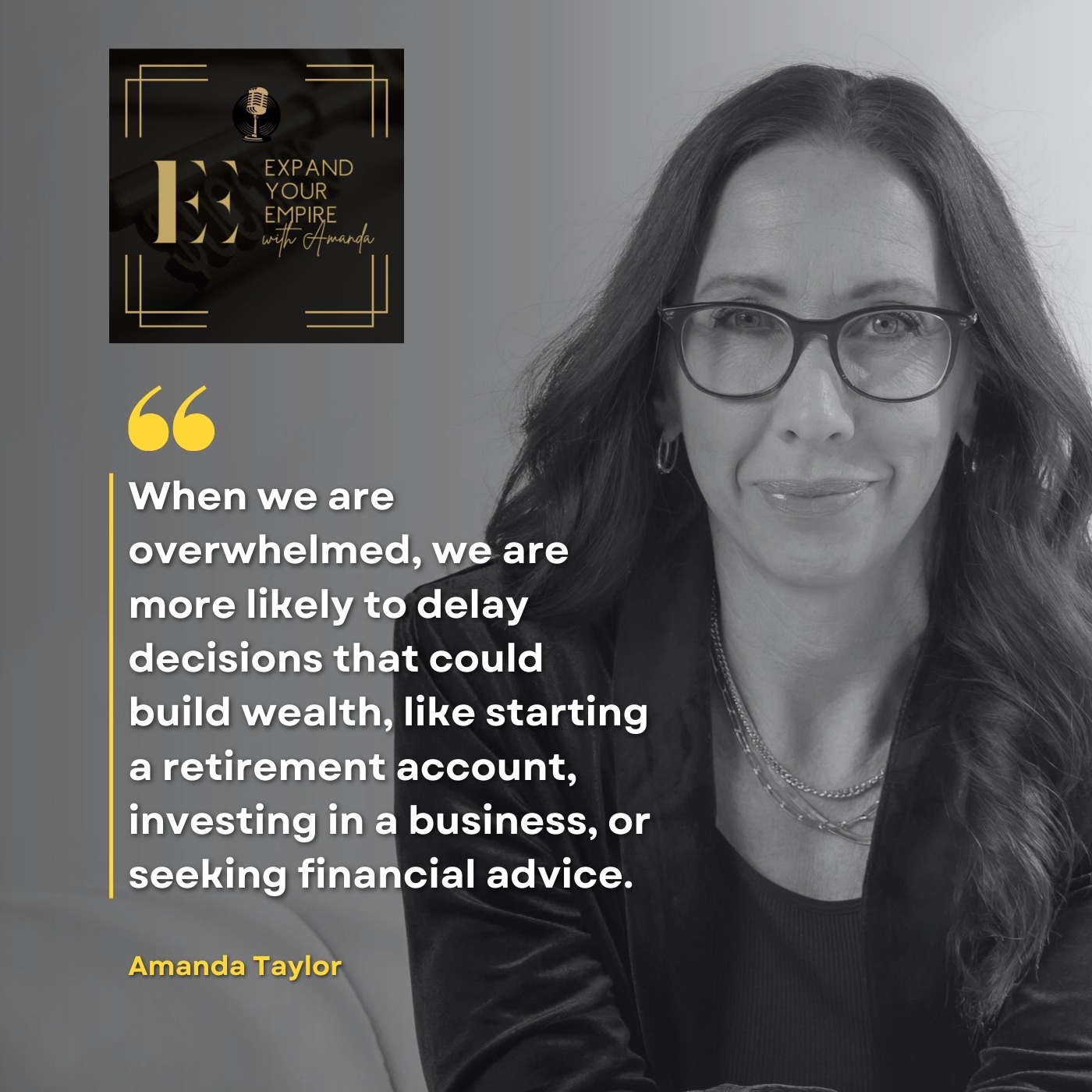
That is decision fatigue and action. It doesn’t just steal your focus. It chips away at your money and your confidence. It can also show up in everyday spending, buying things that you don’t need just to feel that quick hit of relief, or skipping the financial planning conversation because it feels too heavy. It can lead to reactive money habits instead of intentional ones. When we’re overwhelmed, we are more likely to delay decisions that could build wealth, like starting that retirement account, investing in the business, or seeking that financial advice or education.
Every decision we avoid because we’re tired becomes a power that we’re giving away. Most women don’t give up control because we don’t care. It’s not apathy. It’s exhaustion. It’s conditioning. It’s the lie that he’s better with money. Women make up 2/3 of all family caregivers in the US. They spend significantly more on caregiving for the men, while we are also increasingly becoming the main breadwinners. No wonder we are tired. Tired is not the same as incapable.
Why Women Deal With Lower Confidence, Not Lower Competence
Let me tell you something. You know I love my data. Women are 33% more likely than men to defer their decisions to a partner. I did it. It’s not because they don’t know enough. It’s because they think they don’t know enough. Studies show that 30% to 35% of that financial literacy gap between men and women is due to lower confidence, not lower competence. When women take the “I don’t know” option out of financial questions, women are more likely to choose the correct answer. Eighty percent of the time, they get it right if they don’t get the option to choose “I don’t know.” Eighty percent are correct answers.
This is not a knowledge problem. This is a confidence gap. It explains up to half of what we thought was this gender gap in financial literacy. Imagine how different the conversation would be if women knew they already knew. What do we do instead? We’re not going to get less tired. We’re not going to get less tired. We’re not going to have fewer decisions. The fatigue isn’t going anywhere. Life is full. Work is demanding. The mental load is real.
Here’s the shift. It’s not about doing more. It is about doing what matters first. That’s why I’m not asking you to pay attention to every decision. I’m asking you to identify the ones that hold the most power, like your money or your finances. When you get intentional with your money, it becomes a tool to buy back your time, your energy, and your choices. Think of it this way. A fifteen-minute monthly check-in each week can save you hours of stress later. A basic understanding of your investments can help you sleep better at night. Asking one clarifying question in a financial conversation can shift your entire dynamic.
Doing An Awareness Audit And Learning A New Financial Concept
What I want us to take away from this episode is to have an awareness audit. Ask yourself, “Where am I unconsciously outsourcing power?” Even if it’s not money, where is it in your life? Let’s talk about that financial literacy habit. Pick one financial concept to learn about this month because you already have the foundation. We just need to build confidence and a decision filter. Before you say, “You handle it,” ask yourself, “Do I trust this, or am I avoiding this?”
[bctt tweet=”Pick one financial concept to learn about this month because you already have the foundation. You just need to build confidence and a decision filter. ” via=”no”]
Let me leave you with this one story. A close friend of mine, who was in her early 30s and with three kids, lost her husband unexpectedly. It’s tragic. What she didn’t know was that they had no life insurance, none. She was left grieving, scared, and scrambling. That’s not just tragic. That’s preventable. We don’t need to control everything, but we do need to be in the room. We need to know what questions to ask. If this episode woke something up in you, good. It should because you are not just smart enough, you are powerful enough. You don’t have to do it alone.
Join our Expand Your Empire community. This is a space where women are learning, investing, and leading with intention. We’re doing it together. You don’t have to have it all figured out. You just have to show up. I hope to see you in there. I hope to see you back here next episode. We are going to continue to show up, to learn, to build that confidence, and to show up in our power. Thank you for coming to Expand Your Empire. I will see you next time.
Important Links