

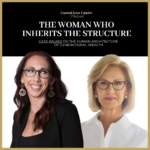


The Woman Who Inherits the Structure: Cate Wilkes on the Human Architecture of Generational Wealth
Watch The Podcast:
Listen To The Podcast:
“So you have the governance, you have the successor plans, you have the tax strategy, you have the capital strategy, the allocation strategy. And a question that kept coming up for me as I was in some of these meetings… is how are we equipping the human that’s going to sit in those structures that’s going to have to operate and manage and lead and decision and judge, and where’s the wisdom coming from? And if family members have not had a seat at the table, then how do we equip them?”
That is Cate Wilkes. And the question she just asked is the one this entire conversation turns on.
Families spend years and serious money building the structures that hold private wealth—the governance, the succession plan, the tax strategy, allocation strategy, all of the things, and they spend really nothing preparing the person who will eventually have to make decisions inside all of it. A lot of the time that person is a woman who was never in the room while any of it was being built.
On Expand Your Empire with host Amanda Taylor, accomplished women are moving from wealth creators to capital allocators. Cate Wilkes is the founder and CEO of 638 Capital. She spent her career as a Fortune 50 executive and a Big Four adviser, and her work now sits at the intersection of private capital and what she calls the human architecture of generational wealth. She is in the rooms where allocation decisions get made, and she works privately with a very small number of women who are walking into these rooms for the first time.
Cate’s core argument: The distance between knowing something and deciding from it has more to do with identity than information.
Three Chapters & The Ocean of Consciousness
Cate outlines three distinct chapters in her professional journey: starting in financial services and housing finance, excelling in corporate structures without fully understanding the underlying science, stepping away in late 2018 to hire Bob Proctor as her coach, and learning at a soulful level how results are truly generated through universal principles like the law of circulation and the law of compensation.
“Think about consciousness as the sea or the ocean, and then all the things that are in the ocean, it could be marine life, it could be carnage, it could be trash, it could be seaweed. That’s how our minds are like the ocean. Consciousness is like the ocean, and then the thoughts, the beliefs, the habits are the things that sit in that consciousness. We think, act, and operate from that preconditioned environment. If I wanted a certain result, I had to have a certain condition in my consciousness to be able to think, act, and operate from that belief.”
In private capital, this mindset directly dictates funding and allocation capability:
“Consciousness really is the path to capital, and capital is an outpouring of consciousness. The way that we allocate, the way that we analyze, the way that we decision any kind of investment really comes from the beliefs that are embedded in the consciousness.”
What is Human Architecture?
While corporate circles refer to “human capital,” Cate rejects the term in private family wealth as too impersonal. Instead, she focuses on the internal operating system required to carry structural wealth across generations:
“Human architecture is really: how am I deliberately building my consciousness? Paradigms are simply mental habits that are stored in the subconscious mind. So, if I’m a family member and I’m standing to inherit in this next generational wealth transition, but I’ve never had a seat at the table, then my identity might be something like, ‘Well, women don’t have a seat at the table’ or ‘I’m just the daughter’… It’s important for those beliefs to rise to the surface so they can be repatterned. Because if a woman is coming to the table, she’s never had a seat at the table and all of a sudden she thinks, ‘Well, I’m just the daughter,’ how effective is she going to be able to lead? She’s going to react from that belief or defer her power to someone that she perceives has more authority than she does.”
Leading Indicators vs. Lagging Indicators
Addressing the gap between intellectual understanding and physical embodiment, Cate re-frames how we view outcomes and results:
-
The result is a lagging indicator.
-
The thought is the leading indicator.
“If I’m focused on lagging indicators, I’m always looking behind… In the results formula—thought, feeling, action, result—you have an idea, you get excitement, you take action, and maybe on your first pitch you get zero dollars. Over time, the common way is that people begin to take the result and make it the thought and the feeling, getting that same result over and over again. Instead, take that result only as feedback, without getting emotionally in harmony with the result you didn’t want, and use that feedback to go back to the thinking.”
Transformation requires structured support and time-space repetition:
“In physics, there’s a principle: the system with the least diversity conducts the most energy. Think about water going through a dam versus water in a lake. Water forced through a structure of support creates an enormous amount of energy and momentum forward. It’s the same principle in our thought… Studies show that 90 days is the minimum for someone to transform their thinking from the old way of being to the new way of being.”
Speech Patterns, Feminine Energy, & Presence
When sitting down with female leaders and family office heirs, Cate listens for speech patterns, self-definitions, and how women view themselves in relationship to the opportunity:
“A man will apply for a job if he thinks he’s 60% qualified, and a woman won’t apply unless she’s got 100% of everything on the job description. That is representative of how women have been conditioned in our society… What’s coming to light now is that feminine energy is a very powerful creative energy—the softer cultivation of influence versus that hard driving hunter style. There’s a need for both.”
“When you can stand or sit in your knowingness or not knowingness and still exude the same authority, that’s true power.”
The Paradox of Surrender & “Living in the Dirt”
How do you move toward a massive goal without destructive attachment or doubt? Cate illustrates this through her experience building her home by the beach:
“I bought the lot, and I would go and sit in the lot—sit in the dirt where my kitchen was going to be, where the outdoor living space was going to be, where the deck was going to be. Living in the dirt… embodying the feeling of being there. Within five months we started construction, and several months later I was in that house.”
“Surrender means: I have an idea, I’m open to the possibility, and there are ways that I don’t even know right now that are going to come to me… As I go about my day, I think to myself from time to time: ‘Am I acting like the woman who already has that?’ If the answer is no, it’s good, because it means there’s a behavior that rose up that needs to be repatterned.”
Practical Application: The 7-Day Thought-Log Exercise
To create tangible self-awareness and map out preconditioned mental chatter, Cate prescribes a strict discipline for clients:
-
Set top-of-the-hour alarms on your phone for every waking/working hour for 7 consecutive days.
-
At the chime, stop and ask yourself one question: “What am I thinking right now?”
-
Write the exact thought down in cursive in a small physical notepad (a 59-cent pad kept in your purse or pocket).
-
Analyze the written log after 7 to 30 days to observe your exact thought patterns, morning-to-night tendencies, and preconditioned beliefs.
Replacing Beliefs at Will
Cate notes that beliefs are neither fixed nor complicated to undo:
“A belief is just a thought you think over and over again. It’s a repetitive looping, and it may be looping for decades… But a belief can be re-evaluated at any time. If you have a belief that continually gets you what you don’t want, you don’t have to do a deep family history dive into who first said it. Simply notice: ‘This is not a belief that’s working for me right now. What can I believe instead? How can I replace that belief so that my thoughts and actions are aligned with this new belief?’ It’s as simple as that.”
Connect with Cate Wilkes
LinkedIn: https://www.linkedin.com/in/catewilkes/